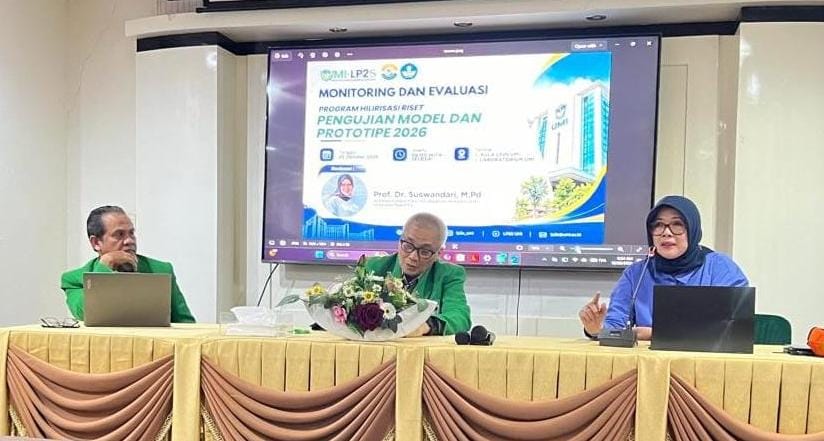
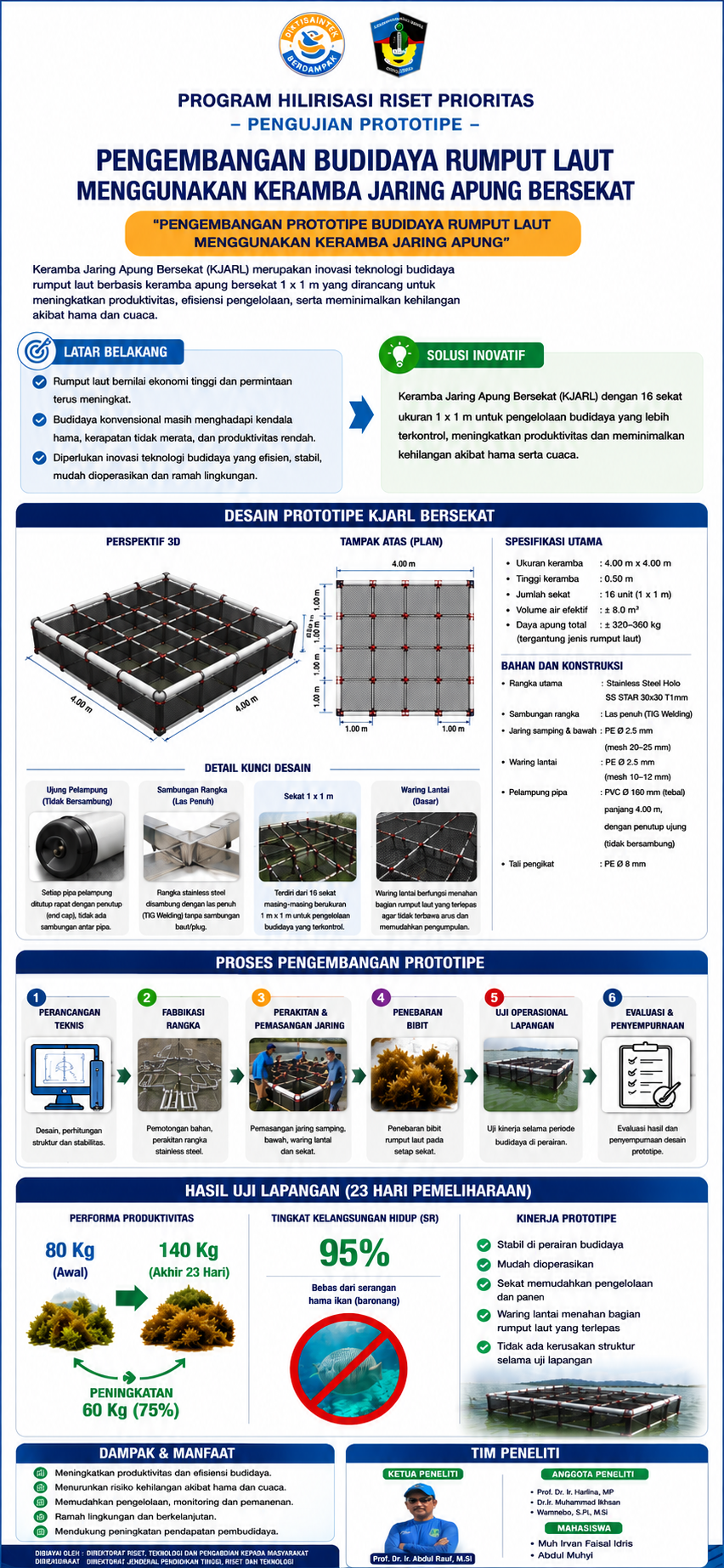
The prototype is part ofPriority Research Downstream Program – Prototype Testingwith title“Development of Seaweed Cultivation Using Insulated Floating Net Cages”.
The development of the Bersekat KJARL was motivated by the high economic value and increasing demand for seaweed. On the other hand, conventional cultivation still faces a number of obstacles, including productivity that is not yet optimal, vulnerability to pests and disease, and the use of cultivation technology that is not yet fully efficient and environmentally friendly.
Through the partitioned KJARL design, the cultivation area is divided into:16 plots measuring 1 x 1 meterin one sized cage unit4 x 4 meters. This system is designed to facilitate the management and monitoring of seaweed while reducing the risk of loss due to pests and weather conditions.
Productivity Increases 75 Percent
Field test results during23 days maintenanceshows promising performance. Seaweed biomass increases from80 kilograms in initial conditions becomes 140 kilograms at the end of maintenance.
Thus, there is an increase in biomass of60 kilograms or around 75 percent.
In addition to increased productivity, the prototype also demonstrated an achieved survival rate95 percent, with relatively stable seaweed conditions during maintenance.
Test results also show a number of operational advantages. KJARL Separated ratedstable in aquaculture waters, easy to operate, makes management and harvest easier, and does not experience structural damage during observation.
These advantages are important in developing more productive and sustainable seaweed cultivation. The government itself continues to encourage the development of seaweed as a strategic commodity for aquaculture and part of the blue economy agenda.
Designed to be Environmentally Friendly
In terms of construction, the prototype uses a number of materials designed to support operations in the aquatic environment, among other thingsPVC pipe, stainless steel frame, PE rope, and PVC float.
The development of this technology is also in line with the direction of strengthening productive, quality and sustainable seaweed cultivation. The Ministry of Maritime Affairs and Fisheries has also previously developed various area-based seaweed cultivation models as well as tissue culture seed technology to improve the quality and productivity of these commodities.
Six Stages of Development
The development of the Bersekat KJARL prototype was carried out through six main stages, namely:
- Technical design, including design, structural calculations, and stability.
- Frame fabrication, in the form of manufacturing and assembling a prototype frame.
- Net assembly and installation.
- Spreading seedsseaweed.
- Field operational testduring the maintenance period.
- Evaluation and improvementbased on test results.
It is hoped that this series of developments will produce cultivation technology that is not only able to increase production yields, but is also more practical for cultivators to apply.
Encourage Downstream Research
The development of the Bersekat KJARL is a form of utilizing research results to answer real problems in the seaweed cultivation sector. Innovations like this have the opportunity to be developed further through testing on more diverse scales and water conditions.
With initial results in the form ofa 75 percent increase in biomass and a 95 percent survival rate, the Sealed KJARL prototype shows prospects as an alternative seaweed cultivation technology that is productive, efficient and adaptive.
In the future, technology development and validation still needs to be carried out through further testing so that prototype performance can be confirmed in various environmental conditions and production scales. This step is important to push the research results towards a wider application stage and provide real benefits for the seaweed cultivating community.
Research team:
Chief Researcher:Prof. Dr. Ir. Abdul Rauf, M.Sc.
Research members and students are listed in the program documentation.