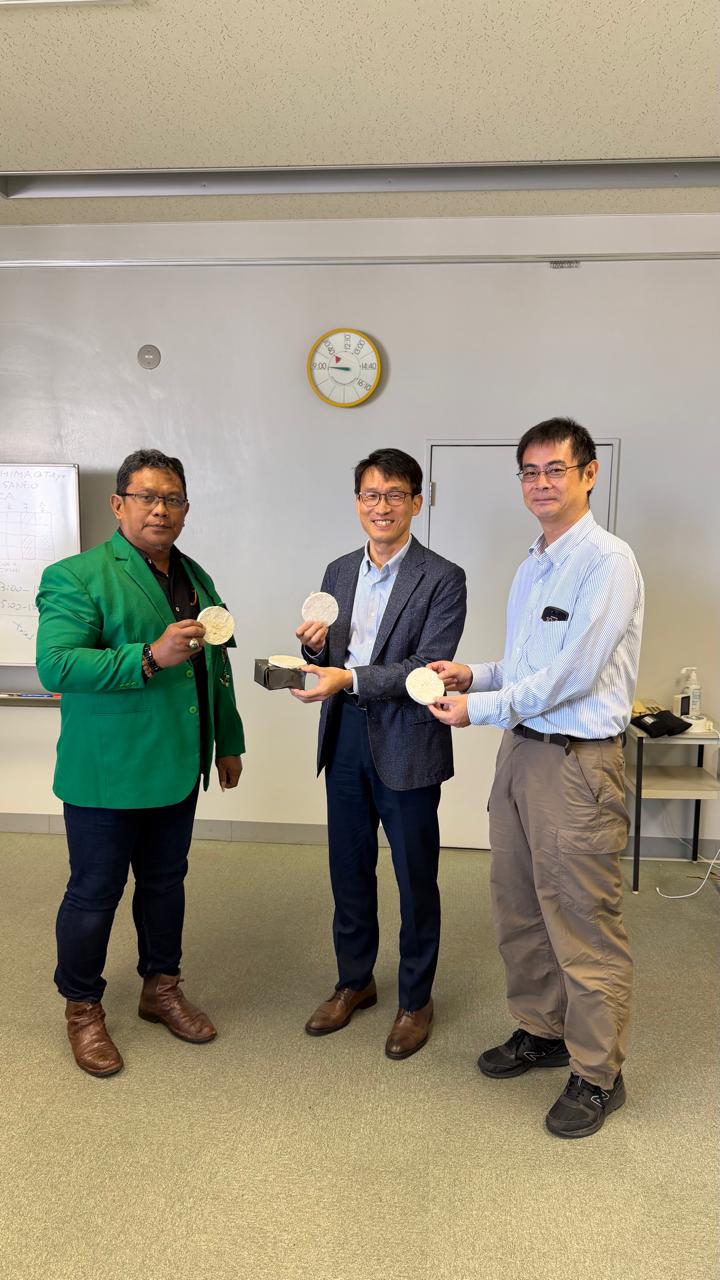
MAKASSAR– Indonesian Muslim University (UMI) continues to encourage the strengthening of international research networks and the downstreaming of research results through the development of environmentally friendly material innovations. One of these steps was demonstrated by a lecturer in the Architecture Study Program, Faculty of Engineering, UMI,Dr. Ir. H. Ansarullah, S.T., M.T., IPM., ASEAN Eng., which is exploring academic and research collaboration opportunities with Nagoya City University, Japan.
The collaboration exploration which took place on Wednesday, October 28 2026, focused on the development and downstreaming of alternative materials in the form of panels made from chicken feathers which have the potential to be used as building materials.
This innovation is an effort to utilize livestock waste into value-added products through a material technology approach. Apart from opening up opportunities for the development of alternative building materials, this research also leads to the application of sustainability principles and more optimal use of resources.
Dr. Ansarullah said that the collaboration with Nagoya City University is expected to open up space for knowledge exchange, strengthening scientific perspectives, as well as opportunities for testing and developing materials to meet the needs and standards of application in the construction sector.
Exploring this collaboration is also a strategic step in encouraging research results so that they do not stop at academic publications, but can be developed further to the stage of implementation and use by society and industry.
For Indonesian Muslim University, this initiative is in line with efforts to expand international collaboration, improve the quality and relevance of research, and strengthen the downstreaming of innovations that have real impacts.
Through the development of this chicken feather waste-based material, UMI shows its commitment to encouraging technological innovation that is oriented towards sustainability while bringing local research potential to the level of international collaboration.
From waste to innovation, from research to downstreaming, UMI continues to encourage academic work that has an impact on society and sustainable development.