Becoming a "Fun" Lecturer
Between Closeness, Example, and Professionalism
(Andi Aladin, Character Training Facilitator – LP2S UMI)
In today's digital era, students no longer only need lecturers who are good at explaining material. They also need an educator who is able to build a comfortable, communicative and inspiring learning atmosphere. "Fun" lecturers do not mean losing academic authority, but are able to provide learning that is more humane and enjoyable.
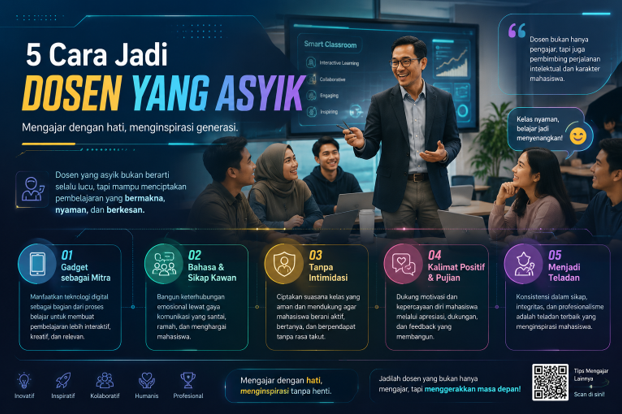
Becoming a lecturer that students like is actually not a complicated matter. There are several simple approaches but have a big impact on the learning process. Here are 5 tips for becoming a fun lecturer developed from writings fromhttps://www.duniadosen.com/5-cara-jadi-dosen-yang-asyik/.
- Utilizing Technology as a Learning Partner
The current generation of students live side by side with digital technology. Therefore, the use of gadgets, learning applications, interactive videos and online platforms can be a bridge to increase student engagement in class.
Lecturers who are adaptive to technology usually find it easier to attract student attention. Learning becomes more dynamic, less monotonous, and feels closer to their daily lives.
However, technology is not the main goal, but rather a tool to strengthen the quality of interaction and understanding of learning.
Interruption
It is time for lecturers not to always view cell phones as the "enemy" in the classroom. Students should not be immediately prohibited from carrying or activating cellphones during the learning process. In fact, these devices can be directed into effective and enjoyable learning media.
In class discussions, students can be asked to look for quick references, watch short videos, take polls, access journals, or discuss via digital platforms interactively. In this way, cellphones are no longer a source of distraction, but turn into a means of collaboration and scientific exploration.
Classes also feel more lively, communicative, and closer to the learning culture of today's digital generation.
- Prioritize friendly language
One of the strengths of lecturers that students like is the ability to communicate warmly without losing professional boundaries. Language that is too formal and stiff sometimes makes students reluctant to ask questions or discuss things.
On the other hand, a communication style that is relaxed, friendly, and respectful of students can create positive emotional closeness. Students feel more valued as learning partners, not just learning objects.
This kind of closeness often makes the class atmosphere more lively.
Interruption
However, the friendly atmosphere in class should also prevent you from going too far and losing marks. Lecturers must still maintain academic dignity, ethics and authority as educators.
Casual language does not mean eliminating politeness. Politeness values, eastern culture, and religious norms must still guide communication between lecturers and students.
A healthy closeness is a closeness that still respects the boundaries of ethics, manners and professionalism. In this way, the learning atmosphere remains warm, but still has character and dignity.
- Avoiding Intimidation in Learning
Not a few students actually have great potential, but are afraid to appear because of the tense classroom atmosphere. Lecturers who are too easy to blame, embarrass, or put excessive pressure can kill students' courage to develop.
Good learning should be a safe space to think, try, and even make mistakes. When students feel comfortable, they will be more active in asking questions, giving opinions, and being involved in the learning process.
Comfortable classes often produce much more effective learning than stressful classes.
Interruption
However, a comfortable atmosphere in the classroom does not mean eliminating academic discipline. Lecturers still need to maintain strictness towards rules, learning ethics, task responsibilities and scientific culture.
Students must still be accustomed to thinking critically, respecting time, being disciplined, and being ready to accept correction in an adult manner. Educative warnings are still necessary, as long as they are delivered proportionally and do not undermine the student's dignity.
In this way, the class does not become a space of intimidation, but also does not turn into a space that is too loose without academic direction and responsibility.
- Give Positive Sentences and Appreciation
Simple praise sometimes has a tremendous impact on students. Sentences like"your answer is good","interesting way of thinking", or"Please develop it again"can increase students' self-confidence.
Appreciation does not mean pampering, but a form of appreciation for their efforts and learning process. Lecturers who are able to provide positive energy usually find it easier to raise students' learning motivation.
In many cases, students remember the lecturer's attitude more than the contents of the presentation slides.
Interruption
However, giving praise also needs to be done proportionally and educationally. Too much praise without clear measurements can actually make students quickly feel satisfied and less ready to face criticism.
Lecturers need to instill that appreciation is not just to please students, but to encourage a better learning process. Therefore, praise should be accompanied by direction, evaluation and challenges to continue to develop.
A healthy academic culture is a culture that is able to balance between appreciation and improvement. Students need to feel appreciated, but also guided to remain humble, open to input, and continue to improve their quality.
- Be a role model in attitude and ethics
In the end, the main strength of a lecturer is not only his knowledge, but his example. Students pay attention to how their lecturers speak, act, are disciplined, respect time, and treat other people.
Example is the most powerful educational method. Lecturers who consistently demonstrate integrity, ethics and professionalism will more easily gain respect from students.
Being a "fun" lecturer doesn't mean you have to always be funny or follow all student trends. What is more important is to present learning that is warm, meaningful and humanizes students.
Because in essence, the best education is born from a healthy relationship between knowledge, example and caring.
Interruption
Being a role model also does not mean that lecturers have to appear perfect without any shortcomings. Lecturers are still humans who continue to learn, develop and adapt to changing times.
However, the most important thing is that there is consistency between words and actions. Students are usually quicker to pick up on real examples than just long advice.
Therefore, simple things such as arriving on time, respecting students' opinions, maintaining communication ethics, being honest in academics, and showing a passion for lifelong learning actually constitute very strong character education.
Exemplary behavior is not built by image, but by good habits that are continuously practiced in everyday academic life.
Conclusion:
Hopefully we can all be "fun" lecturers, not only in the way we teach, but also in the way we guide, inspire and humanize students. And hopefully, from semester to semester, we will continue to learn to become increasingly fun, wiser and more meaningful educators for future generations.